
The Spark – Open Roads and the Birth of the Motor Truck (1898–1910)
Imagine it’s a humid late-August afternoon in 1898 in Cleveland. Your family gathers at the in-laws after church for the usual Sunday meal. Your brother-in-law Jerry sits across from you, noticeably agitated, a real departure from his usual jolly demeanor. You lean in and ask, “Jerry, why the long face?”
“Sales are down at work,” he sighs. “These motor cars and trucks people are inventing are threatening the entire equine business. They say in the future horses might only be in museums or those zoological experiences.”
You chuckle and tell him not to worry. “Those silly things are far from viable. They’ll never replace a good horse.”
The next morning you’re walking to work down Euclid Avenue and grab the morning paper from the stand. You stop for a quick coffee and stand on the sidewalk reading the Plain Dealer. An opinion piece declares that horses will soon vanish from city streets forever. Jerry’s worried face flashes across your memory.
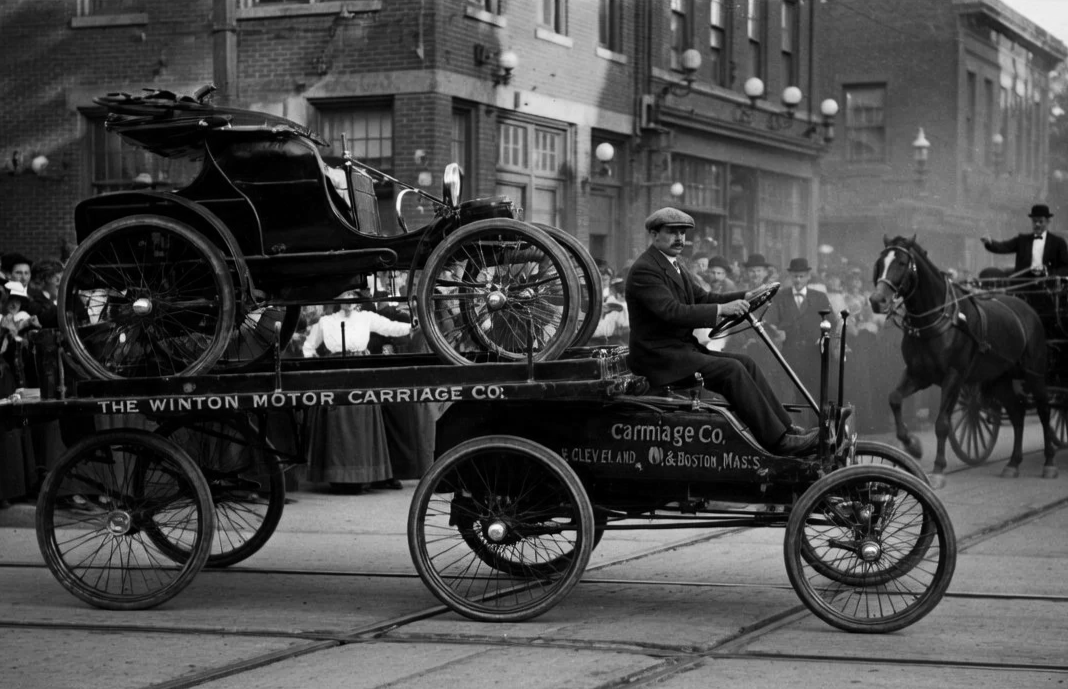
Suddenly a low mechanical rumble cuts through the clatter of hooves and carriage wheels. Alexander Winton, a Scottish immigrant who arrived with nothing but bicycle-making skills, eases past in his converted automobile, a makeshift semi-truck. One of his own cars secured on the back.
You freeze. The newspaper slips from your fingers and flutters toward the street. Scrambling to grab it before it blows away, you notice everyone around you is staring in awe. The age of the motor truck has just begun, and over the next few years it will explode in prominence faster than you or Jerry ever imagined.
That ordinary Sunday conversation and the next morning’s shocking sight on Euclid Avenue capture the exact moment when everything started to shift. What looked like a silly novelty to most people was about to become the foundation of a brand-new industry.
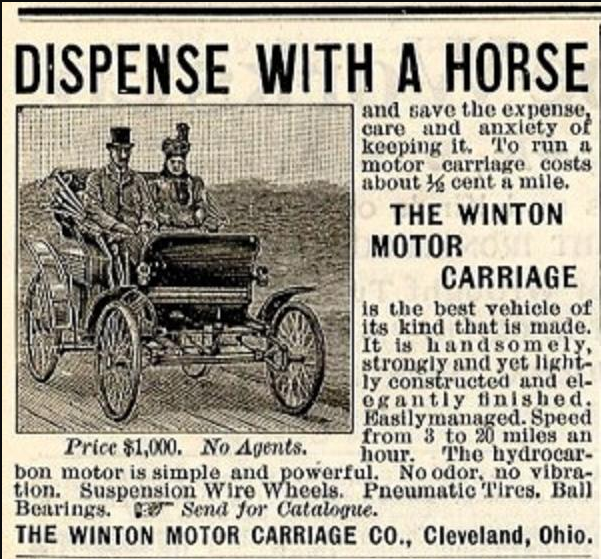
Alexander Winton had a very practical problem. He was building automobiles in Cleveland, but the rough, unpaved roads destroyed the cars before customers could even drive them off the lot. His solution was simple yet revolutionary: he bolted a trailer onto the back of one of his cars and created what historians now recognize as the first semi-truck in the United States. By late 1898 that rig was already hauling finished automobiles through the streets, proving the motorized freight truck just may replace the horses of the day.
Winton wasn’t alone. The late 1890s and early 1900s were a frenzy of experimentation. In Ardmore, Pennsylvania, the Autocar company (founded in 1897 as the Pittsburgh Motor Vehicle Company) began producing commercial trucks as early as 1899 and is often credited with building the first true gasoline-powered truck sold in America. The earliest cab over design with an optional five or eight horsepower engine and 700 pound capacity. In Brooklyn, New York, the Mack brothers (August, William, and John) started what would become Mack Trucks. They began with bus bodies and heavy-duty gasoline engines around 1900–1905. Their early trucks were especially popular in busy port cities like New York, Philadelphia, and Baltimore, where they hauled cargo straight off ships to warehouses and factories. In Cleveland, the White Motor Company (originally a sewing-machine maker) entered the truck business around 1900, producing early delivery vehicles for department stores. International Harvester (formed in 1902) and the Reliance Motor Car Company (later part of GMC) also rolled out early commercial models.
These companies, many founded or staffed by immigrant mechanics and engineers, turned the motor truck from a novelty into a practical tool almost overnight.
This explosion happened during the tail end of the Gilded Age and the opening years of the Progressive Era. William McKinley was president when Winton took that first drive. The Spanish-American War had just ended in 1898, giving the United States new overseas territories and a surge of national confidence. High protective tariffs fueled industrial growth, and cities were exploding with factories that needed reliable freight movement.
When McKinley was assassinated in 1901, Theodore Roosevelt became president and the Progressive Era accelerated. Roosevelt’s Square Deal promised fairness for workers, consumers, and businesses. He went after giant trusts, signed the Pure Food and Drug Act and Meat Inspection Act in 1906, and pushed the Hepburn Act, dramatically strengthening the Interstate Commerce Commission and giving it real power to set maximum railroad rates and inspect their books.
The railroads (still the undisputed kings of the long haul) were already watching these noisy little motor trucks with growing unease. They saw this new competition as a direct threat to their monopoly. Quietly, they began lobbying for rules that would limit the trucks’ freedom. Those early whispers inside the ICC were the first faint signs of the regulatory capture that would eventually reshape the entire industry.
Culturally, Americans were obsessed with modernization, efficiency, and rugged individualism. The motor truck fit the moment perfectly, it was the ultimate “motor cowboy,” a machine that promised to conquer distance and time. Auto shows in New York and Chicago drew huge crowds. Newspapers ran excited stories about the coming “horseless age.” Yet the same Progressive spirit had a darker side. “Americanization” campaigns were in full swing. Immigrants (who made up a large share of the mechanics, drivers, and early owners) were expected to shed their old-world ways quickly. Nativist sentiment simmered beneath the surface, even as these same immigrants kept the new industry moving.
Daily life for the first truck drivers was brutal and unforgiving. There were no paved interstates, no air brakes, and solid rubber tires that shredded on gravel. A typical run might start at dawn with a load of manufactured goods or coal. The driver would nurse a temperamental gasoline engine for 10 to 12 hours, fix flat tires on the roadside with hand tools, and pray the cargo didn’t shift and destroy the entire rig. Every mile carried full personal liability, if the load was damaged, it came out of the driver’s own pocket. Immigrant drivers often faced extra prejudice, with customers questioning their reliability or accents even while depending on their trucks to keep factories running.
Trucking was still tiny on a national scale with less than half a percent of the entire workforce. But immigrants were already overrepresented in ownership and driving roles. Foreign-born whites made up roughly 15 percent of the population, yet they showed up in far higher numbers in these new transportation trades because the entry costs were low and the work rewarded anyone willing to get dirty and stay hungry.. an issue that would rear its head multiple times over the industries history and even more so today.
Meanwhile, the International Brotherhood of Teamsters, founded in 1903 as a merger of horse-team drivers’ unions, was quietly watching. By 1910 the union was beginning to shift its focus from wagons to the new motor trucks.
That 1898 drive down Euclid Avenue wasn’t the end of anything. It was the very beginning. Those first immigrant inventors and drivers proved the motor truck could work. They laid the literal and cultural groundwork for an entire industry.
But the same open roads and lack of rules that let them build something from nothing would soon be tested by war, flooded with bootleg liquor, and eventually choked by the very chaos they created, chaos the railroads and the ICC were already preparing to exploit.
In the next episode we step into 1910–1919, when those early trucks went to war, came home, and the first real cracks started to appear in the open-road dream.